
Your own personalised stalker
It always seemed slightly creepy that your computer shows advertising that is strangely accurately targeted at things you might have been interested in. On the surface, that seems quite useful. If you have to tolerate ads on your screen, at least having them show things you were interested in seems helpful.
Instead, we wonder how the system knows. It feels like a breach of our privacy.
It all starts when you install an app, and it pops up a question asking for permission to use your location, and/or your camera and/or your microphone.
This is useful for advertisers. For example, they can use your location. If the app reports this back to the content provider, they can match up your location and compare you to other people nearby. If you tend to go to the same places as other people, you are probably interested in the same things, so an advertiser might use that assumption to present advertising to you, or other people that you spend time with.
That does sound a bit overreaching, but we reluctantly agree to the presented terms simply because we want to use the app. If that is a condition of use, and we want to use the app, then we agree.
So, now we are seeing consumers getting the choice to push back.
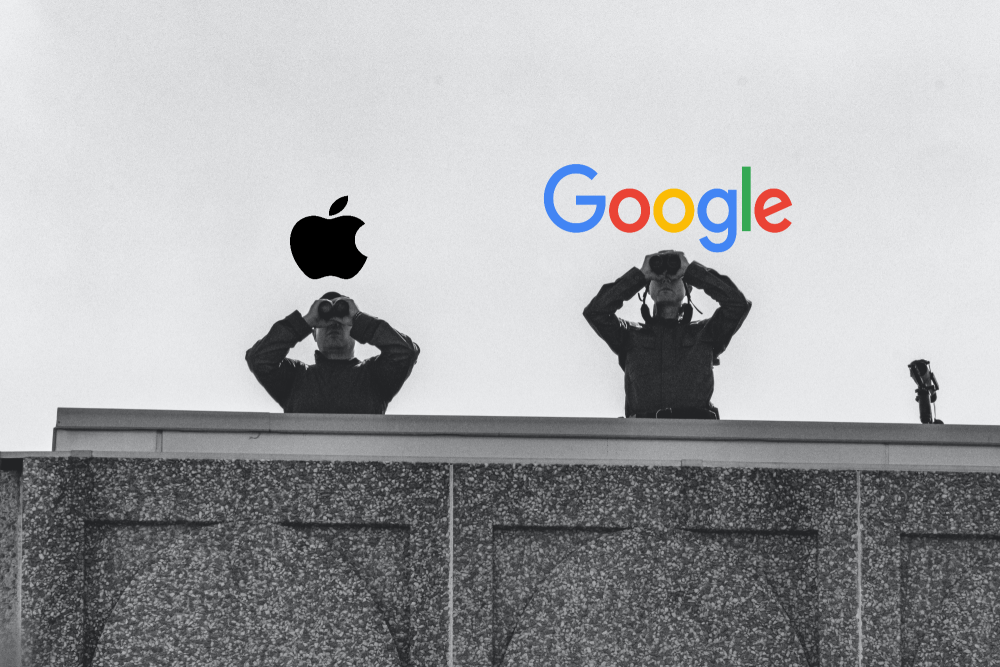
Apple
Now, with iOS15, Apple are saying that you will get to see what apps are accessing your data. You will be able to see when an app used that permission, and there it was sent to. Whether that list of third party sites is any use or not is meaningful is unclear.
Not quite as advanced but following quickly behind is Google Android. With Android 12, you will have the option to de-personalise your data. They will still track usage, but won’t link it back to you.
Is there any truth to the rumour that your phone or TV is listening to you, and presented content based on private conversations it overhears?
Given how poor the voice recognition is on phones , cars, or tools like Alexa or Siri, its pretty evident this can’t be reality. If it, is, then heaven only knows what it thinks it’s hearing. The voice recognition tools are getting better all the time, but there is a long way to go.
5 Quick IT Wins That Cut Costs in 90 Days
5 Quick IT Wins That Cut Costs in 90 Days A survival guide for NZ professional services, charities & manufacturers under pressure.Cheaper Biscuits & No Colour Printing? Yep, times are tough. The NZ economy is putting pressure on every dollar. The lunchroom...
Webinar Replay – Securing the Mobile Frontier: Cybersecurity Essentials for Phones and Tablets for Modern Businesses
As mobile devices become the backbone of modern business operations, they also present a growing target for cyber threats. Apple or Android - they're both important. Every time you use these to access your Teams, Email or anything else, you are relying on them to be...
Can Copilot tame your Outlook Inbox?
Is your email inbox overflowing? You’re not alone. Managing a busy inbox can be time-consuming and draining. The average professional deals with around 100+ emails a day, and over half of those could be spam or trivial notifications2. Every new email interrupting your...
Meet our upgraded Remote Engineering Team
Listening to your feedback You've told us that we need to step up our initial call contacts. We understand. These days, responsive and efficient support is not just a value-add—it is a necessity. As organisations grow, so too does the complexity of their...
Device Code Phishing: A Dangerous New Scam You Need to Know About
Device code phishing is a sneaky new way hackers are stealing people's online accounts. In device code phishing, threat actors exploit the device code authentication flow to capture authentication tokens, which they then use to access target accounts, and further gain...
Microsoft News – What you need to know about Windows and Teams changes
Microsoft have announced some changes that will impact nearly everyone. Some of these remain fluid and we will update you as soon as we know more.Microsoft Teams Unbundling Update In response to a European Commission antitrust case initiated by Slack in 2020,...
June AI Digest
AI wants to stay 'on'. Hot on the heels of Anthropic's blackmail experiment, OpenAi had a similar problem. Researchers have observed that their newest model, o3, does not consistently follow commands, particularly in relation to shutting down. In a series of...
Did AI really try to blackmail its operator?
AI attempts blackmail to avoid being turned off. During pre-release testing in May 2025, Anthropic (maker of claude.ai) conducted extensive safety evaluations using controlled scenarios to test the model's behaviour under extreme conditions. The company embedded...
New Zealand’s AI Revolution: How Artificial Intelligence is Transforming Productivity in 2025
New Zealand is experiencing a remarkable transformation in 2025, with artificial intelligence driving unprecedented productivity gains across diverse industries. According to recent surveys, 82% of New Zealand organisations now use AI in some capacity, representing a...
AI-Driven Productivity Gains in New Zealand (2025)
New Zealand’s businesses are experiencing notable productivity increases in 2025 due to the use of Artificial Intelligence (AI). Across diverse industries – from manufacturing floors to rural farms – AI technologies are streamlining operations, cutting costs, and...